
How to register a car from the Netherlands in Norway
This page follows a Dutch car through Norway customs, the approval at Statens vegvesen, the one-off registration tax and the registration. We prepare the Dutch export papers from €50; you handle the Norwegian steps, or leave the customs declaration to a customs agent.
- Seven Norwegian steps in the right order
- Dutch export papers from €50
- Free advice before you set off
from €50
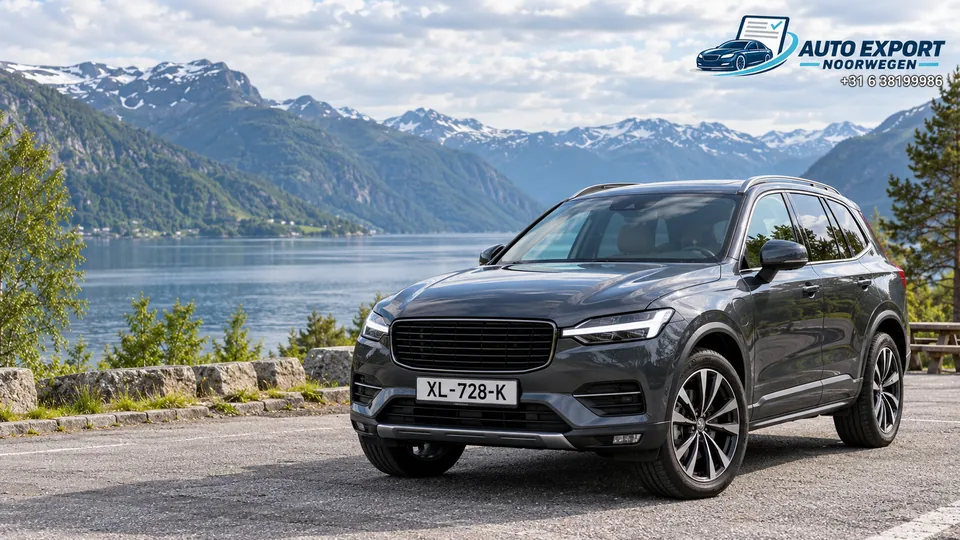

Importing a car into Norway involves three Norwegian authorities and seven steps, and they have to happen in the right order. Miss one link, such as valid insurance, a CoC or the transit deadline, and the whole chain waits. Below you will find the steps as Statens vegvesen (the Norwegian Public Roads Administration) lists them, with who does what and where things tend to go wrong.
Auto Export Noorwegen handles the Dutch start of the chain at our RDW-recognised desk in Hengelo. Customs clearance, approval, the one-off registration tax and registration in Norway are done by the buyer or new owner. Tolletaten mentions that you can also use a professional customs agent (speditør) for the declaration; that is allowed, not compulsory.
Dutch deregistration and technical checks before departure
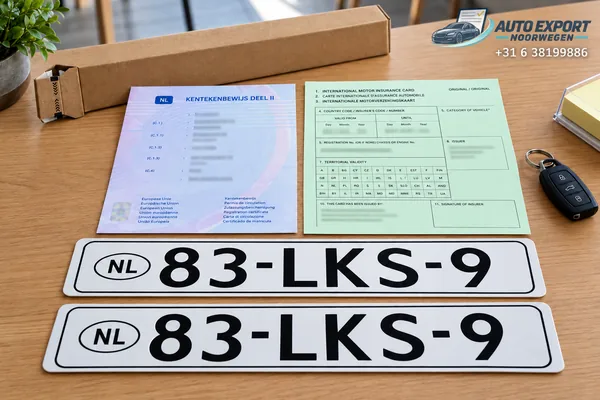
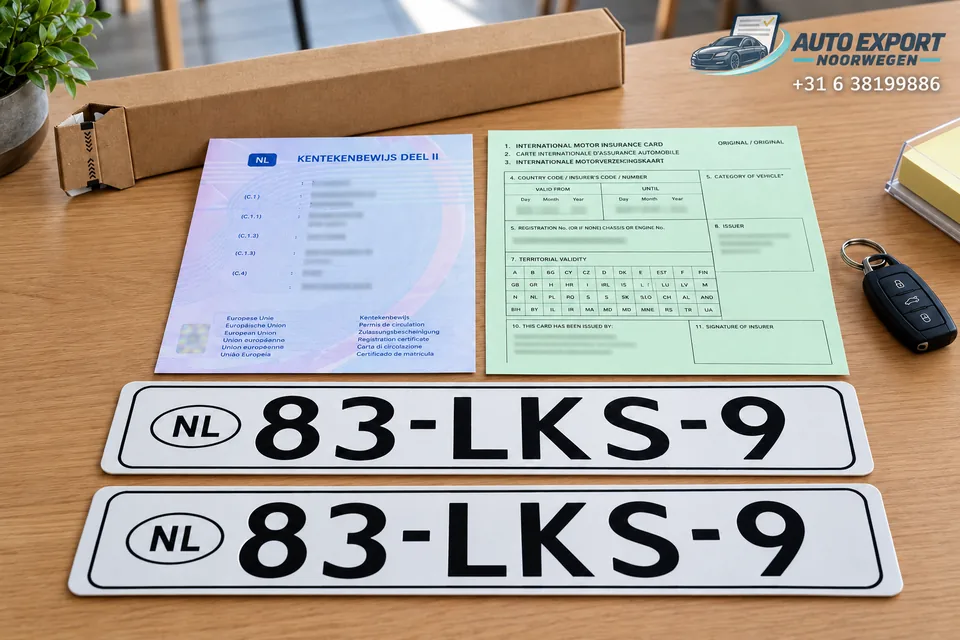
At our desk the car is deregistered for export. The buyer receives the export certificate (exportbewijs, also called kentekenbewijs deel II) and the registration card with a corner cut off; according to the RDW, both go to the organisation abroad where you register the car. The seller receives the vrijwaringsbewijs, the proof that the Dutch registration has ended. See export documents for Norway for the full list. Because Norway is outside the EU, the car also needs an export declaration with Dutch Customs, the EX-A document.
Two checks before you set off save time later. Ask Statens vegvesen which technical requirements apply to your vehicle for registration in Norway; Tolletaten gives the same advice. And Skatteetaten recommends checking that the car has valid plates and insurance for the drive to and in Norway. That is where our white export plates and export insurance come in.
Norway customs: arriving at the border
Statens vegvesen puts it simply: "Use the serviced border crossing and declare your arrival in the red zone." Declaring on the spot is only possible at land border crossings, with one exception: the Utstikker II customs office in Oslo. If you arrive by ferry, you either travel in transit to a customs office or hand the declaration to a customs agent.
In transit you drive with a transit document (transitteringsdokument) that states where you must declare the car; if the foreign customs did not issue one, the Norwegian border customs will. The deadline is normally 1 to 3 days after you arrive in Norway. Miss it, and Tolletaten can impose an infringement fee (overtredelsesgebyr). Check the opening hours of the destination customs office in advance. Valid foreign plates may be used up to that customs office if the vehicle is insured; a car that is not insured at the border needs separate border insurance (Grenseforsikring) from Tolletaten.
Customs clearance and 25% VAT at Tolletaten
Tolletaten (Norwegian Customs) charges 25% VAT (merverdiavgift, mva) on the value of the vehicle plus the freight and insurance costs. If you have just bought the car, the customs value is the purchase price. Tolletaten makes no distinction between new and used vehicles here. For electric cars in 2026, VAT is charged only on the amount above NOK 300,000. On top of that comes a tax on the greenhouse gases in the air conditioning (avgift for klimagass). Arriving over land, you can pay VAT at the border crossing; ask the crossing about it beforehand.
After clearance the car may be driven for up to 30 days on valid foreign plates if it is insured and technically roadworthy. Keep the registration and customs papers to hand, and leave the import declaration in the car until the approval. Otherwise you need Norwegian temporary plates (prøveskilt): NOK 340 per day, according to Statens vegvesen.
Vehicle approval: EU type approval or individual approval
All imported vehicles must be approved by Statens vegvesen, and used vehicles are checked at a trafikkstasjon (Driver and Vehicle Licensing Office). Book the test in the category "First-time approval", and only once the car has been cleared through customs. You pay when booking or within three working days, and you are told then which documents to bring.
A vehicle is approved either through an EU type approval or by individual approval (enkeltgodkjenning). A car previously approved in an EU or EEA country is approved on the basis of the exporting country's approval, unless it is considered a traffic hazard or has been modified since. Skatteetaten lists the CoC (certificate of conformity) among the documents for clearance, and without a CoC Statens vegvesen has to check the vehicle. We offer CoC guidance on request.
The one-off registration tax (engangsavgift)
After the approval and before the registration, you pay the one-off registration tax (engangsavgift) and the vehicle scrap deposit tax (vrakpantavgift) to Skatteetaten (the Norwegian Tax Administration), in its payment solution or through your online bank. Whoever pays becomes the declarer of the vehicle and is responsible for the tax.
- A car with a combustion engine pays for its CO2 emissions plus a weight component; an electric car pays only the weight component.
- The NOx tax was abolished with effect from 1 January 2026.
- If CO2 data are missing, Skatteetaten calculates the emissions from the kerb weight. A used car with only an NEDC value has its CO2 figure adjusted upwards by a factor of 1.24.
- A used car gets an age deduction (bruksfradrag) from Skatteetaten's table, counted from the first registration abroad to the first registration in Norway: for example 19% once the car is over one year old, 50% at five years and 90% at ten, rising to 100% at twenty. Instead, you can apply for an alternative calculation based on price and mileage within 15 working days after registration; that choice is binding.
- For vehicles over 20 years old you do not need to apply in advance: Statens vegvesen applies the exemption or reduction at registration.
The amount for your car comes from Skatteetaten's import cost calculator. We do not calculate or pay it.
Norway car registration at a trafikkstasjon
Registration is by appointment at a trafikkstasjon. First the ownership is confirmed ("Godkjenn eierskap"), either through "Din side" or at the trafikkstasjon with the signed form "Melding om registrering" and valid ID, such as a passport or driving licence. The owner does this, or someone with written authorisation. You hand in the foreign registration certificate, both parts for an EU-model certificate, and the foreign number plates. Norwegian traffic insurance must be in place; the insurer sends the insurance declaration to Statens vegvesen electronically.
You leave with a temporary registration certificate, which is not valid for driving abroad; the vognkort, the Norwegian registration certificate, follows by post. Number plates cost NOK 70 each or NOK 140 per set, according to Statens vegvesen, which mentions two to five working days for plates that are ordered.
Deadlines when you import a car to Norway
- Transit: declare within the deadline on the transit document, normally 1 to 3 days after arrival.
- After clearance: up to 30 days on valid foreign plates, if insured and roadworthy.
- Inspection: pay when booking or within three working days.
- Bruksfradrag: an alternative calculation within 15 working days after registration.
- BPM (Dutch registration tax): for a Dutch BPM refund, the car must be registered in Norway within 13 weeks of the RDW status Export.
There is no official average processing time. As an indication, with complete papers (CoC, invoice, both parts of the registration certificate) and an available appointment at Statens vegvesen, the Norwegian steps usually take a few days to a few weeks. If the wait is longer, extend the export insurance in time.
Five mistakes that hold up a car import
- Using an unstaffed border crossing instead of reporting to the red zone at a staffed one.
- Missing the transit deadline, which can lead to an infringement fee.
- Booking the inspection before the car has been cleared through customs.
- Arriving without a CoC, so that Statens vegvesen has to check the vehicle.
- Letting the export insurance expire while you wait for an appointment: the vehicle must always be validly insured.
Is the car already in Norway on Dutch plates? We can still arrange the Dutch export remotely by post, insured with DHL: standard in about 5 working days, DHL Express in about 1 working day. Contact us first; we will then also discuss the export declaration. Moving house rather than buying? Moving to Norway with a car adds a few rules. Our own rates are shown below and on the costs page.
| Service | Included | From |
|---|---|---|
| Export document | Export certificate, vrijwaringsbewijs (indemnification certificate) and RDW processing | €50 |
| Export insurance + white plates | 14 days liability cover, Green Card and white export plates | €100 |
| Complete export package | Export document, vrijwaringsbewijs, 14 days liability cover, Green Card and plates | €150 |
| Export insurance extension | 14 extra days of liability cover with a Green Card, requested online (per 14 days) | €120 |
When can the price be higher?
- All amounts are starting prices, including VAT where applicable.
- A surcharge may apply outside office hours. Office hours: Monday to Saturday 10:00 to 16:30. On Sundays you are welcome by appointment, at a higher rate; call or WhatsApp first for the final price.
- Postal delivery costs more; the same postal rate applies to the Netherlands and abroad.
- The price can differ per vehicle, for example for heavy or non-standard vehicles.
- You always know the price in advance.
All rates, including postal delivery, caravans, trailers and custom work, are on the page Prices and costs for Norway.
Exporting today?
Call or message us for free advice or an appointment, also outside office hours. On Sundays a higher rate applies; you always know the price in advance.
Norway car registration: questions on Tolletaten and Statens vegvesen
Can I declare the car at any Norwegian border crossing?
No. You must use a staffed border crossing and report to the red zone. Declaring on the spot is only possible at land border crossings, with the Utstikker II customs office in Oslo as the exception. Arriving by ferry, you travel in transit to a customs office or use a customs agent (speditør).
Do I pay Norwegian VAT if I already paid Dutch VAT on the car?
Tolletaten charges 25% VAT (mva) on import, on the value of the car plus freight and insurance. Whether Dutch VAT can be refunded is a matter between buyer and seller; Norwegian Customs has nothing to do with that.
When can I book the vehicle inspection at Statens vegvesen?
Only after the car has been cleared through customs. Book it in the category First-time approval and pay when booking or within three working days. You are told which documents to bring when you book.
How is the one-off registration tax worked out for a used car?
For a car with a combustion engine, Skatteetaten uses CO2 emissions plus a weight component; electric cars pay only the weight component. A used car gets an age deduction (bruksfradrag) from a fixed table. Skatteetaten's calculator gives the amount for your car; we do not calculate it.
What happens if my car has no CoC?
Skatteetaten lists the certificate of conformity among the documents for customs clearance, and without one Statens vegvesen has to check the vehicle. We offer CoC guidance on request; the route varies by manufacturer and importer.
How long may I drive on foreign plates after customs clearance in Norway?
Up to 30 days on valid foreign plates, provided the car is insured and technically roadworthy and you carry the registration and customs papers. The rules for Dutch export plates vary by country, and whether white export plates count as valid foreign plates is something to check with Tolletaten or Statens vegvesen first; otherwise use prøveskilt.
Sources on Norway customs and car registration
- Tolletaten (Norwegian Customs): Importing cars and other vehicles
- Statens vegvesen (Norwegian Public Roads Administration): Import of vehicles
- Skatteetaten (Norwegian Tax Administration): How to import
- Skatteetaten (Norwegian Tax Administration): One-off registration tax
- Skatteetaten: Bruksfradragstabellen
- Statens vegvesen (Norwegian Public Roads Administration): Order temporary number plates
Checked on 1 November 2026